Black hole accretion disks
How matter spirals into a black hole, why the disk glows in X-rays, and what current models still can't explain.
Radical Researchers Society is the student-run research club at Fremont High School. Every Tuesday at lunch in Room 136 we sit down with a real scientific paper (physics, biology, computer science, math) and take it apart together until it makes sense. No jargon gatekeeping, no prerequisites: just students figuring out real science line by line.
We were founded by students who wanted a place where curiosity counted more than credentials. Since then the club has grown into a small research community that reads papers, records breakdowns for our YouTube channel, and helps members write and present work of their own.
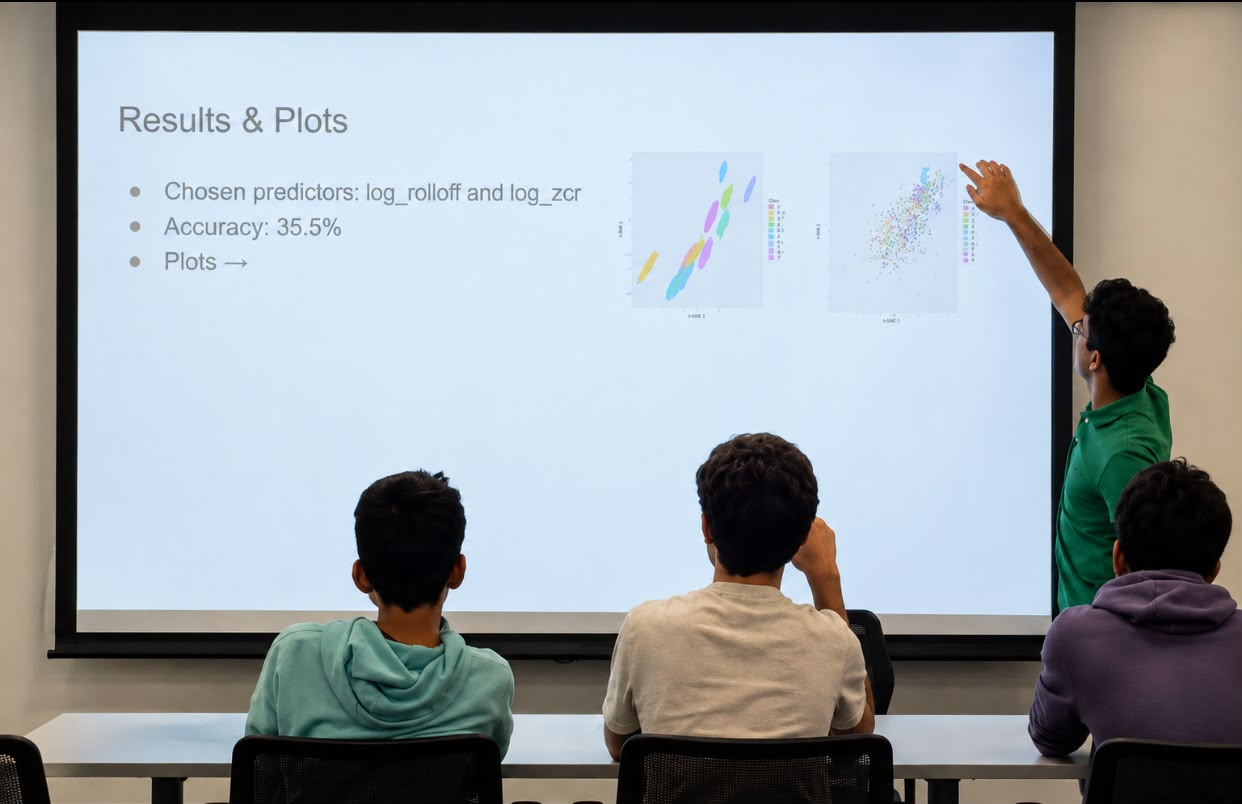
Bringing the research community together at Fremont High.
The Radical Researchers Society is a new club geared towards raising awareness about research, and to bring this community together. Our club's mission is to create a community supporting people to write, explore, and learn about cutting edge research.
Our members and speakers include Harvard and Caltech admits. The research topics discussed have ranged from black hole accretion disks, to novel solutions for unsolved logic math puzzles, to the implications of AI deception.
A sample of the papers and workshops our members have led in Room 136.
How matter spirals into a black hole, why the disk glows in X-rays, and what current models still can't explain.
Members walked through novel approaches to logic problems that don't have a clean published answer yet.
What it means when a language model learns to mislead, and how researchers test for it in the lab.
The paper behind modern AI, unpacked from the ground up: tokens, attention heads, and why it replaced RNNs.
Using real bio papers to learn how experiments are designed, controlled, and reported honestly.
A workshop on turning ten pages of dense text into a five-slide story an audience actually follows.
A snapshot of what happens in Room 136 every week.
Break down complex research papers step by step with weekly guided reading sessions across CS, biology, physics, and chemistry.
Present research findings with polished slide decks and receive real, friendly feedback from peers and officers.
Build the academic skills that matter for college applications, science fairs, and independent research projects.
The club is run entirely by students, with no dues and no auditions, every meeting is planned and led by our own members.
RRS is not a lecture series. These are the six things our members actually practice together, week after week.
Use Google Scholar, PubMed, and arXiv to find credible, readable sources in any field.
Skim abstracts, map figures, and extract the main claim without getting lost in equations.
Ask what the authors actually did, what they measured, and what could be stronger.
Turn a dense paper into a clear one-page summary your peers can actually understand.
Design visual decks that keep an audience focused on the story, not the wall of text.
Practice pacing, eye contact, and handling Q&A in a low-pressure, supportive room.
Nobody is thrown into the deep end. This is the arc we've watched our members follow across a semester.
Show up, listen in, follow along with paper breakdowns. No pressure to speak, present, or bring anything.
Ask questions, help discuss papers, and try our cheat sheets on your own reading. Optional: co-lead a short segment.
Give your own paper breakdown or original-research talk. Officers help you scope, review slides, and rehearse.